
What to See on an Amsterdam Canal Cruise: A Full Guide
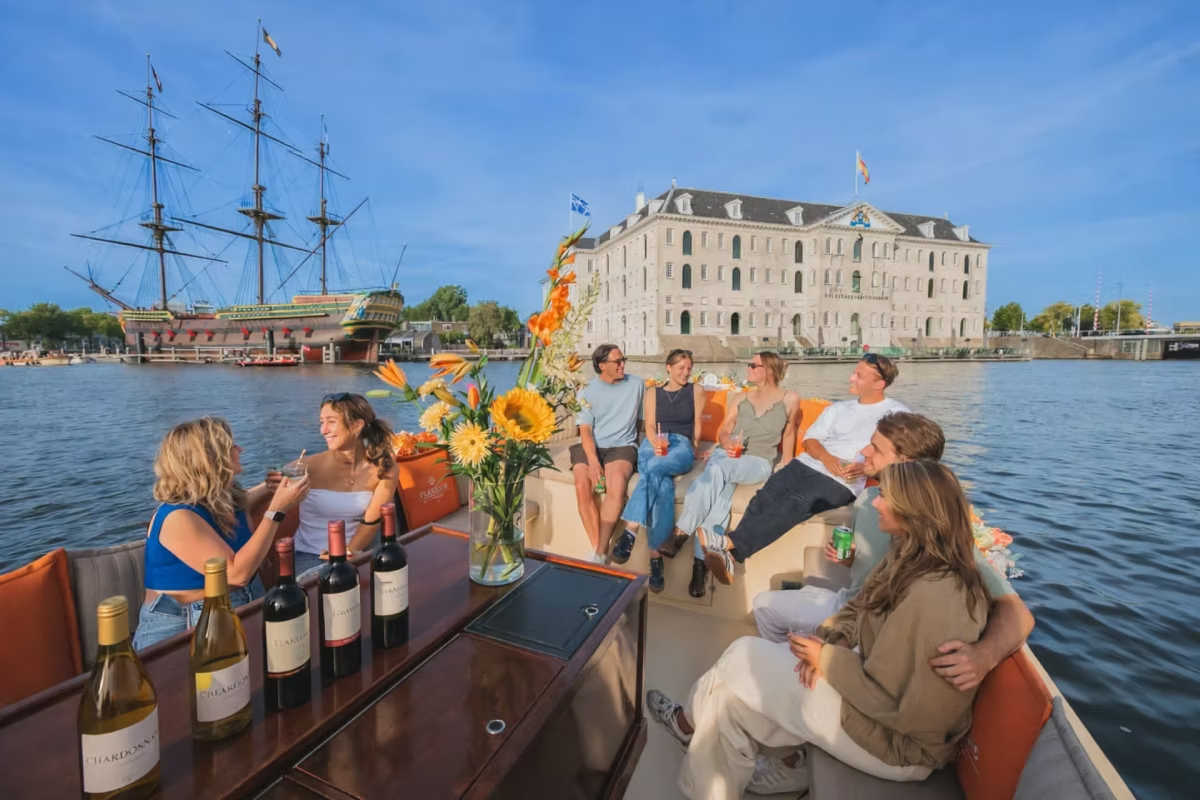
On an Amsterdam canal cruise you will see the 17th-century canal houses lining the Prinsengracht, Keizersgracht, and Herengracht — Amsterdam’s three UNESCO-listed concentric canals. Key landmarks include the Anne Frank House at 263 Prinsengracht, the Westerkerk tower, the Golden Bend on the Herengracht, the Magere Brug (Skinny Bridge) over the Amstel River, and more than 1,500 historic bridges. The route also passes the Jordaan neighbourhood and sections of the Amstel River.
An Amsterdam canal cruise takes you through one of the most historically layered and visually extraordinary urban waterway systems in the world. The canal ring was built in a single generation during the 17th century — the Dutch Golden Age — and remains largely intact, a working neighbourhood of canal houses, bridges, and waterways that has barely changed in four centuries. What you see from the boat is not a museum reconstruction but the actual city, lived in and used daily by Amsterdam’s residents.
This guide covers every significant thing you will see on a standard Amsterdam canal cruise — the major landmarks, the canal architecture, the neighbourhoods, and the details that most visitors notice only after they have been pointed out.
Top Tickets
The Three Great Canals of Amsterdam
Amsterdam’s canal cruise route covers the three concentric canals of the grachtengordel — the Prinsengracht (Prince’s Canal), Keizersgracht (Emperor’s Canal), and Herengracht (Gentlemen’s Canal). These three canals were dug during the Dutch Golden Age between 1613 and 1665 as part of a planned urban expansion. They form concentric arcs from the IJ waterway in the north to the Amstel River in the south, creating the canal ring that UNESCO inscribed as a World Heritage Site in 2010.
The canal ring’s three main waterways each have a distinct character:
The Prinsengracht (Prince’s Canal) is the outermost of the three and arguably the most varied. It runs through the Jordaan neighbourhood on its western bank — Amsterdam’s most charming and historically residential district — and is lined with canal houses that range from modest 17th-century workers’ dwellings to grand merchant residences. The Prinsengracht is also where the Anne Frank House is located, making it the canal with the most historically significant single address.
The Keizersgracht (Emperor’s Canal) is the widest of the three concentric canals and was named for Holy Roman Emperor Maximilian I. It was the most prestigious address during the Golden Age — wider than the Prinsengracht but less exclusive than the innermost Herengracht. The Keizersgracht’s canal houses are consistently grand and well-preserved, with a particular concentration of fine 17th and 18th-century architecture.
The Herengracht (Gentlemen’s Canal) is the innermost and most prestigious of the three. The name refers to the heeren — the regents and wealthy merchants — who built their grandest houses here. The Herengracht contains the Golden Bend: the most architecturally distinguished stretch of the entire canal ring, where the wealthiest Amsterdam merchants commissioned the widest, tallest, and most elaborately detailed canal houses.
The Anne Frank House
The Anne Frank House at 263 Prinsengracht is one of the most visited sites in the Netherlands. It is the building where Anne Frank, her family, and four others hid in a secret annex from 1942 to 1944 during the German occupation of Amsterdam. Seen from the Prinsengracht canal, the narrow facade of the building is immediately recognisable from photographs. The Westerkerk tower is visible directly behind it.
From a canal boat on the Prinsengracht, the Anne Frank House is recognisable by its narrow, six-storey facade and the position of the Westerkerk tower rising directly behind it. The building’s modest exterior gives little indication of its significance — 263 Prinsengracht looks like many of its canal house neighbours from the water. The audio guide covers the history of the hiding place and the Frank family’s story as the boat passes.
The museum itself requires advance booking — timed entry tickets through the Anne Frank House’s official website. If a museum visit is on your Amsterdam itinerary, the canal cruise departing from near the Anne Frank House is the most convenient cruise option to combine both.
The Westerkerk
The Westerkerk (Western Church) is Amsterdam’s largest and most prominent Protestant church, built between 1620 and 1631. Its tower — the Westertoren — at 85 metres is the tallest in Amsterdam and a landmark visible from many points along the canal ring. The tower is topped with the imperial crown of Maximilian I, granted to Amsterdam in 1489 in recognition of the city’s commercial importance.
Anne Frank wrote about hearing the Westerkerk’s bells from the hiding place in her diary, describing them as a comfort during the years of concealment. The tower is climbable and the views over the canal ring from the top are exceptional — if you plan to climb it, book the canal cruise separately from the Westerkerk tower visit and allow a morning for both.
The Canal Houses: Architecture and Details
Amsterdam’s 17th-century canal houses are the defining visual feature of the canal ring. They are characterised by narrow facades — typically 6 to 8 metres wide — extreme height relative to width, and distinctive gabled rooflines. The gable styles include the step gable (trapgevel), the neck gable (halsgevel), and the bell gable (klokgevel). Many canal houses lean slightly forward from the vertical — a deliberate architectural feature designed to prevent goods being lowered from the hoisting beams from hitting the facade.
The canal houses along the Prinsengracht, Keizersgracht, and Herengracht were not built to the same design — each was commissioned individually by the merchant family who owned it. The result is a varied but coherent streetscape in which the differences between adjacent houses — different gable styles, different brick colours, different facade proportions — are as interesting as the overall pattern.
Key architectural features to notice from the boat:
Gable styles. The gable is the upper triangular section of the facade, visible above the roofline. The earliest style is the step gable (trapgevel) — a staircase-like outline popular in the early 17th century. The neck gable (halsgevel) with its curving scroll decoration became fashionable later in the century. The bell gable (klokgevel) is the widest and most elaborate, associated with the most prosperous owners.
Hoisting beams. At the very top of almost every canal house, a wooden or iron beam projects from the gable peak. These were used — and some still are today — to hoist furniture and goods to the upper floors, since Amsterdam’s canal house staircases are notoriously steep and narrow for furniture. Many still have hoisting ropes attached.
The forward lean. Amsterdam’s canal houses lean slightly forward from the vertical — typically one degree or more. This was a deliberate design feature: goods being hoisted would swing clear of the facade rather than knocking against the windows. From the canal, you can see this lean most clearly when looking along a straight stretch of canal where the houses recede in perspective.
The foundation posts. Amsterdam is built on sand and peat, and the canal houses are supported on wooden posts driven down to a solid sand layer approximately 12 metres below the surface. The Westerkerk, for example, stands on 2,000 wooden posts. This is why some Amsterdam canal houses lean or tilt — differential settlement over centuries. The posts are preserved by permanent immersion in groundwater; changes in the water table can accelerate decay.
For a dedicated guide to Amsterdam’s canal houses, see our Amsterdam’s most famous canal houses article.
The Golden Bend (De Gouden Bocht)
The Golden Bend (De Gouden Bocht) is the most prestigious and architecturally distinguished stretch of the Amsterdam canal ring, located on the Herengracht between Leidsestraat and Vijzelstraat. During the Dutch Golden Age, Amsterdam’s wealthiest merchants built their most ambitious canal houses here — wider than standard (some are double-width), taller, and more elaborately detailed. The nickname “Golden Bend” reflects both the golden wealth of the residents and the gentle curve of the canal at this point.
From a canal boat, the Golden Bend is immediately recognisable — the canal houses here are notably wider and taller than those elsewhere on the ring, with grander facades, more elaborate gable ornamentation, and a consistent quality of stone and brick that signals exceptional wealth.
The houses on the Golden Bend include some of the finest examples of Dutch classicism and late Baroque architecture in the Netherlands. Several have been converted into museums — the Museum Van Loon (at 672 Herengracht) and the Museum Willet-Holthuysen (at 605 Herengracht) both offer access to period-furnished canal house interiors that give a vivid sense of what Golden Age merchant life actually looked like inside these facades.
The Magere Brug (Skinny Bridge)
The Magere Brug, or Skinny Bridge, is a narrow double-drawbridge over the Amstel River connecting the Kerkstraat on both banks. It is Amsterdam’s most famous bridge and one of its most photographed structures. The current bridge is a reconstruction from 1969, but a bridge has stood on this site since 1691. At night, the bridge is illuminated by hundreds of lights that reflect in the Amstel water below.
The Magere Brug gets its name — “Skinny Bridge” — from its narrowness: the original bridge was just wide enough for two people to pass each other. The current white-painted wooden drawbridge is significantly wider than its 17th-century predecessor but retains the narrow, elegantly proportioned character that makes it one of Amsterdam’s most visually distinctive structures.
Seeing the Magere Brug from a canal boat — approaching it on the Amstel River, passing under it as the drawbridge sections rise for taller vessels — is one of the most satisfying visual moments on any Amsterdam canal cruise. At night, the bridge’s illumination reflects in the dark Amstel water in a way that no towpath view can replicate.
The Amsterdam Bridges
Amsterdam has more than 1,500 bridges — more than any other city in the world. On a standard canal cruise, you pass under and alongside dozens of these bridges. The bridges range from simple wooden footbridges crossing the narrower inner canals to large stone and iron arch bridges spanning the main canal ring. Most bridges date from the 17th to 19th centuries, though many have been rebuilt or restored.
Amsterdam’s bridges are as characteristic of the canal ring as the houses that line its banks. From a canal boat, you experience the bridges differently from the towpath — passing under the arches rather than crossing the surface, seeing the structural underside of bridges that pedestrians walk over without looking at.
The Reguliersgracht is a notable canal for bridge-viewing: from one point on the Reguliersgracht, seven bridges are visible in a single line of sight — a view that appears on countless Amsterdam photographs and postcards. The exact viewing position varies by boat route, but most standard sightseeing cruises pass through or near the Reguliersgracht.
For a dedicated guide to Amsterdam’s bridges, see our bridges of Amsterdam article.
The Jordaan Neighbourhood
The Jordaan is Amsterdam’s most beloved neighbourhood — a dense, intimate district of narrow streets, independent shops, art galleries, and brown cafés (bruine kroegen) on the western bank of the Prinsengracht. The Jordaan was developed in the early 17th century as a working-class district adjacent to the canal ring, and its character today reflects its history — small, human-scaled, and full of the kind of neighbourhood life that Amsterdam’s more touristic areas have lost.
From the canal cruise, you see the Jordaan’s eastern edge along the Prinsengracht — the canal-facing facades of the district’s buildings, the small footbridges crossing into the neighbourhood, and the plane trees that line the towpath. The audio guide covers the Jordaan’s history as you pass. A walk through the Jordaan after the cruise is one of Amsterdam’s most rewarding free activities.
The Amstel River
The Amstel River is the original waterway around which Amsterdam was founded — the city’s name is a contraction of “Amstel dam,” the dam on the Amstel. The canal ring’s canals eventually connect to the Amstel at the southern end of the grachtengordel, and most standard canal cruise routes include a section on the Amstel that gives a different, wider perspective from the more intimate canal ring.
On the Amstel, the views open up — longer sight lines, wider water, and the transition from the enclosed 17th-century canal ring to a more open riverine landscape. The Magere Brug crosses the Amstel, and the Blauwbrug (Blue Bridge) — modelled on the Pont Alexandre III in Paris — is another significant bridge visible on the Amstel section of the route.
What You Cannot See from the Canal
Being honest about the canal cruise’s limitations helps calibrate expectations:
The interior of the canal houses. The facades are visible from the water but the famous interiors — the steep staircases, the period-furnished rooms, the private gardens behind the houses — are not visible from the canal. For the interior experience, visit the Museum Van Loon or Museum Willet-Holthuysen, both of which are period-furnished canal house museums.
The Rijksmuseum and Van Gogh Museum. The major museums are on the Museumplein, which is not on the canal cruise route. A combined visit requires a separate trip — see our canal cruise + Rijksmuseum combo guide.
The narrower inner city canals. The large standard cruise boats navigate the main canal ring (Prinsengracht, Keizersgracht, Herengracht) but are too large for the narrower Jordaan canals and inner city waterways. The small group cruise with maximum 10 passengers navigates some of these narrower stretches.
Frequently Asked Questions
Do you see the Rijksmuseum from the canal cruise?
No — the Rijksmuseum is on the Museumplein, which is not on the standard canal ring cruise route. For a combined experience, see the canal cruise + Rijksmuseum combo ticket.
Can you see the Anne Frank House from the canal?
Yes — the facade of 263 Prinsengracht is visible from the canal cruise as the boat passes along the Prinsengracht. The audio guide covers its significance as you pass.
What is the Golden Bend?
The Golden Bend (De Gouden Bocht) is the most prestigious stretch of the Herengracht, where Amsterdam’s wealthiest Golden Age merchants built their most elaborate canal houses. It is visible from the canal cruise as you navigate the Herengracht.
How many bridges does the canal cruise pass?
A standard 60 to 75-minute cruise passes under and alongside dozens of Amsterdam’s 1,500+ bridges. The exact number depends on the route and operator.
Is the canal cruise the best way to see Amsterdam?
It is the best way to see the canal ring specifically — the water-level perspective on the canal houses and bridges is unique. It complements rather than replaces walking the canals, visiting the museums, and exploring the neighbourhoods on foot. See our is the canal cruise worth it guide for a full assessment.
