
Amsterdam’s Most Famous Canal Houses (And Where to Spot Them)
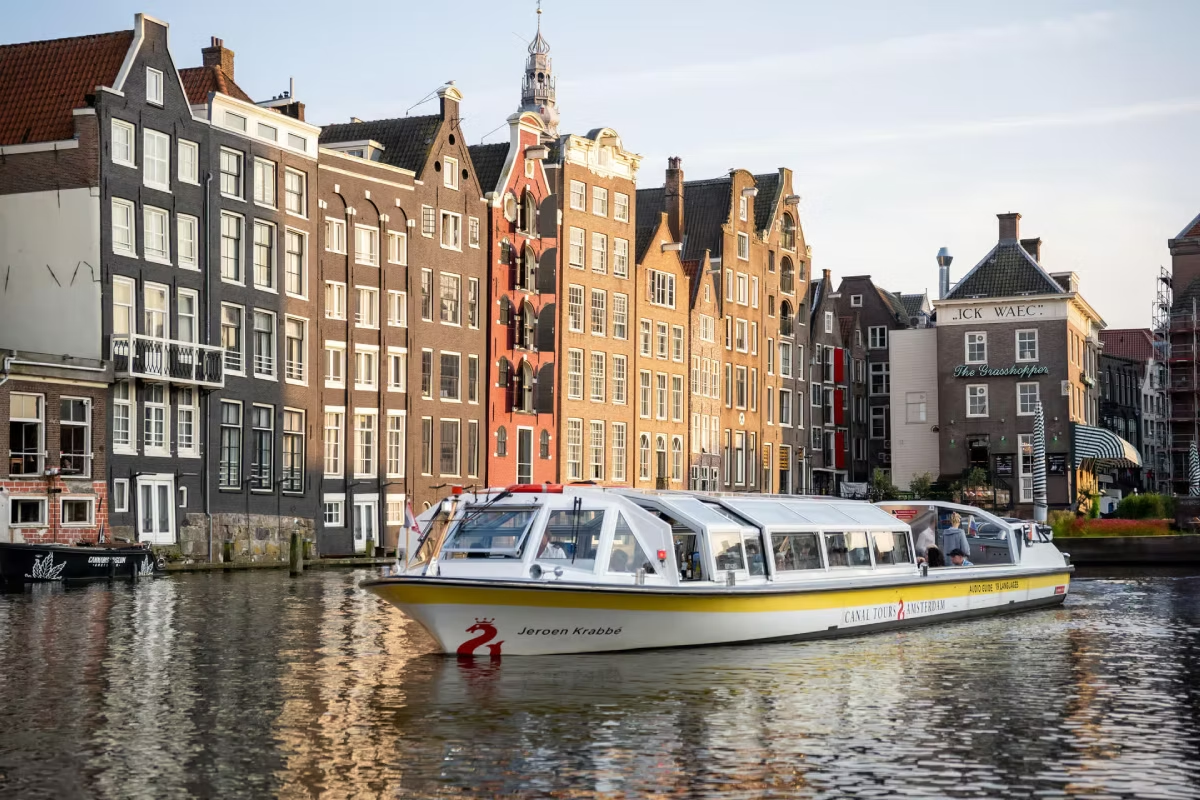
Amsterdam’s most famous canal houses include the Anne Frank House at 263 Prinsengracht, the grand mansions of the Herengracht’s Golden Bend, the Huis met de Hoofden (House with the Heads) at 123 Keizersgracht, and the Groenland Warehouses on the Keizersgracht. The best way to see all of them is on a standard canal cruise, which navigates the Prinsengracht, Keizersgracht, and Herengracht — the three main canals where all the most significant canal houses are located.
Amsterdam has approximately 1,550 historic canal houses lining the Prinsengracht, Keizersgracht, and Herengracht. Most visitors experience the canal ring as a beautiful but undifferentiated ensemble of brick and gables. In fact, individual canal houses have specific stories, specific architectural distinctions, and specific historical significance that make them worth knowing before you visit.
This guide covers Amsterdam’s most notable canal houses — what makes each one significant, where it is on the canal ring, and how to spot it from a canal cruise.
Top Tickets
The Anne Frank House — 263 Prinsengracht
The Anne Frank House at 263 Prinsengracht is the most visited canal house in the world. It is the building where Anne Frank, her parents Otto and Edith Frank, her sister Margot, and four other Jewish individuals hid in a secret annex from July 1942 to August 1944, when they were discovered and deported. Anne Frank was killed at Bergen-Belsen concentration camp in February 1945 at the age of 15. Her diary, kept during the hiding period, was published by her father Otto in 1947 and has since been translated into more than 70 languages.
From a canal cruise on the Prinsengracht, the Anne Frank House is visible as a narrow, six-storey facade — narrower than most of its neighbours — with the Westerkerk tower rising directly behind it. The building was constructed in 1635 and served as a warehouse and business office for the Opekta company owned by Otto Frank before the family moved into the hiding place in the upper rear section (the achterhuis, or annex) in 1942.
The building’s modest appearance from the canal — and from the street — gives little indication of its significance. It looks like a typical Amsterdam canal house of the mid-17th century. The knowledge of what it conceals transforms the experience of looking at it.
The Anne Frank House museum operates timed entry ticketing — book well in advance through the museum’s official website, particularly for spring and summer visits. The canal cruise departing from near the Anne Frank House is the most convenient option for visitors combining both.
The Herengracht’s Golden Bend — Numbers 390–490
The Golden Bend (De Gouden Bocht) is the stretch of the Herengracht between Leidsestraat and Vijzelstraat where Amsterdam’s wealthiest 17th-century merchants built their most ambitious canal houses. The houses on the Golden Bend are notably wider than standard canal houses — several are double-width — with more elaborate gable designs, stone facing on the lower floors, and grand entrance stairs. The section includes some of the finest examples of Dutch classicism and Baroque architecture in the Netherlands.
The Golden Bend contains Amsterdam’s most architecturally extraordinary canal houses. Several specific addresses are particularly notable:
590–592 Herengracht — One of the grandest double-width canal houses on the Golden Bend, with a stone-faced facade and an elaborate neck gable. Built in the late 17th century for a wealthy merchant family.
605 Herengracht — Museum Willet-Holthuysen — One of the few Golden Bend canal houses open to the public. The museum presents the interior as it would have appeared in the late 19th century, when the Willet family lived there. The period rooms, garden, and collection give a vivid sense of what the grandest canal houses looked like inside.
672 Herengracht — Museum Van Loon — A canal house built in 1672, originally housing Flemish painter Ferdinand Bol, later occupied by the Van Loon family for nearly three centuries. The museum preserves period interiors, a garden, and a remarkable collection of Van Loon family portraits.
From a canal cruise, the Golden Bend’s exceptional width and architectural quality are immediately visible — the houses are noticeably grander than those elsewhere on the ring, with more elaborate stonework and wider proportions.
The House with the Heads — 123 Keizersgracht
The House with the Heads (Huis met de Hoofden) at 123 Keizersgracht is one of Amsterdam’s most distinctive canal houses — named for the six stone heads mounted on its facade. The heads represent six classical deities: Apollo, Ceres, Mars, Athena, Bacchus, and Diana. The house was built in 1622 and is one of the finest examples of Dutch Renaissance architecture on the canal ring, with a grand step gable and sandstone detailing.
The six stone heads on the facade of 123 Keizersgracht are impossible to miss from a canal cruise — they are the most striking decorative detail on any single canal house facade visible from the water. The heads are mounted in pairs between the windows of the upper floors, each approximately half life-size and clearly carved with classical features.
The building was constructed for a wealthy Amsterdam merchant named Lous de Geer and designed by architect Philips Vingboons, one of the most significant architects of the Dutch Golden Age canal ring. It is now used as the Amsterdam City Archives’ public reading room.
The Greenland Warehouses — 40–44 Keizersgracht
The Groenland Pakhuis (Greenland Warehouses) at 40–44 Keizersgracht are a row of three early 17th-century warehouses built for the storage of whale oil and other goods from the Dutch Greenland whaling trade. They are among the few surviving examples of early Amsterdam canal ring warehouses and are architecturally distinct from the residential canal houses — their facades are simpler, their windows smaller, and their entire design oriented toward storage and trade rather than domestic display.
The Bartolotti House — 170–172 Herengracht
The Bartolotti House at 170–172 Herengracht is one of Amsterdam’s most celebrated examples of Dutch Renaissance architecture on the canal ring. Built around 1617 for Willem van den Heuvel (who changed his name to Guglielmo Bartolotti to honour his wealthy Italian uncle), the building features a red brick facade with elaborate stone detailing, a stepped gable, and a curved decorated top that reflects both Dutch and Italian architectural influence.
The building is now part of the Theatre Institute Netherlands and is occasionally open to the public for events and exhibitions.
The Skinny Bridge (Magere Brug) Neighbourhood
The stretch of canal ring around the Magere Brug — the Amstel River crossing — contains some of Amsterdam’s most photogenic canal house clusters. The area around the Kerkstraat on both banks of the Amstel has a concentration of well-preserved 17th and 18th-century houses with intact facades and unobstructed water views. From a canal cruise approaching the Magere Brug, the sequence of canal houses on both banks of the Amstel is one of the most rewarding architectural views on any standard Amsterdam sightseeing cruise route.
The House on Three Canals — 249 Grimburgwal
Tucked at the junction of three Amsterdam canals — the Grimburgwal, Oudezijds Voorburgwal, and Oudezijds Achterburgwal — the Huis op de Drie Grachten (House on Three Canals) is a rare example of a canal house with facades facing three separate waterways simultaneously. Built in 1610, it is one of the oldest surviving canal houses in Amsterdam and a visual curiosity that most visitors never discover. The small group canal cruise with maximum 10 passengers, which can navigate narrower waterways, is the best way to see this building from the water.
Gable Styles: How to Read a Canal House from the Water
Understanding the gable styles allows you to date canal houses approximately from the water:
Step gable (trapgevel) — The earliest style, popular from approximately 1580 to 1650. Characterised by a staircase-like profile of diminishing steps. Seen most often on the Prinsengracht and the older sections of the Herengracht.
Neck gable (halsgevel) — Popular from approximately 1640 to 1700. A narrower, rectangular central section with curved scroll ornaments (volutas) on both sides. The distinctive curving scrolls make this the most recognisable gable style on the canal ring.
Bell gable (klokgevel) — Popular from approximately 1660 to 1720. Named for its bell-shaped profile. Wider than the neck gable, with a convex central section and concave flanking curves.
Cornice gable — An 18th-century simplification — a straight horizontal cornice rather than a shaped gable profile. Associated with the neoclassical taste that replaced the Baroque in the 18th century.
From a canal cruise, watching for these gable styles and approximately dating the buildings by their profile gives the canal ring a historical depth that transforms a scenic boat ride into an architectural time-travel experience spanning a century of Dutch building history.
Frequently Asked Questions
Which is Amsterdam’s most famous canal house?
The Anne Frank House at 263 Prinsengracht is the most visited and most historically significant single canal house in Amsterdam — and one of the most visited sites in the Netherlands. Architecturally, the grandest canal houses are on the Herengracht’s Golden Bend.
Can you visit canal houses from the inside?
Two Golden Bend canal houses are open to the public as museums: Museum Willet-Holthuysen at 605 Herengracht and Museum Van Loon at 672 Herengracht. Both preserve period-furnished interiors. The Anne Frank House at 263 Prinsengracht is also open (with advance booking required).
Do people still live in Amsterdam’s canal houses?
Yes — the majority of Amsterdam’s historic canal houses are privately owned residential properties. Most have been converted into apartments, though some retain their original configuration as single-family homes. The canal ring is a living neighbourhood rather than a heritage district, which contributes significantly to its character.
Why do some canal houses lean at odd angles?
Amsterdam’s canal houses are built on wooden pile foundations. Over centuries, differential settlement — where some piles sink more than others — causes buildings to lean. The lean is not always the original deliberate forward lean but can reflect foundation movement. Some canal houses lean significantly sideways as well as forward due to uneven settlement.
What is the most expensive canal house in Amsterdam?
Properties on the Herengracht — particularly on the Golden Bend — are among the most expensive real estate in the Netherlands. Grand double-width Golden Bend canal houses occasionally sell for €10 million or more. The most expensive properties are typically those that have been converted from single institutional use back into residential properties.
