
Bridges of Amsterdam: What You’ll Pass on a Canal Cruise
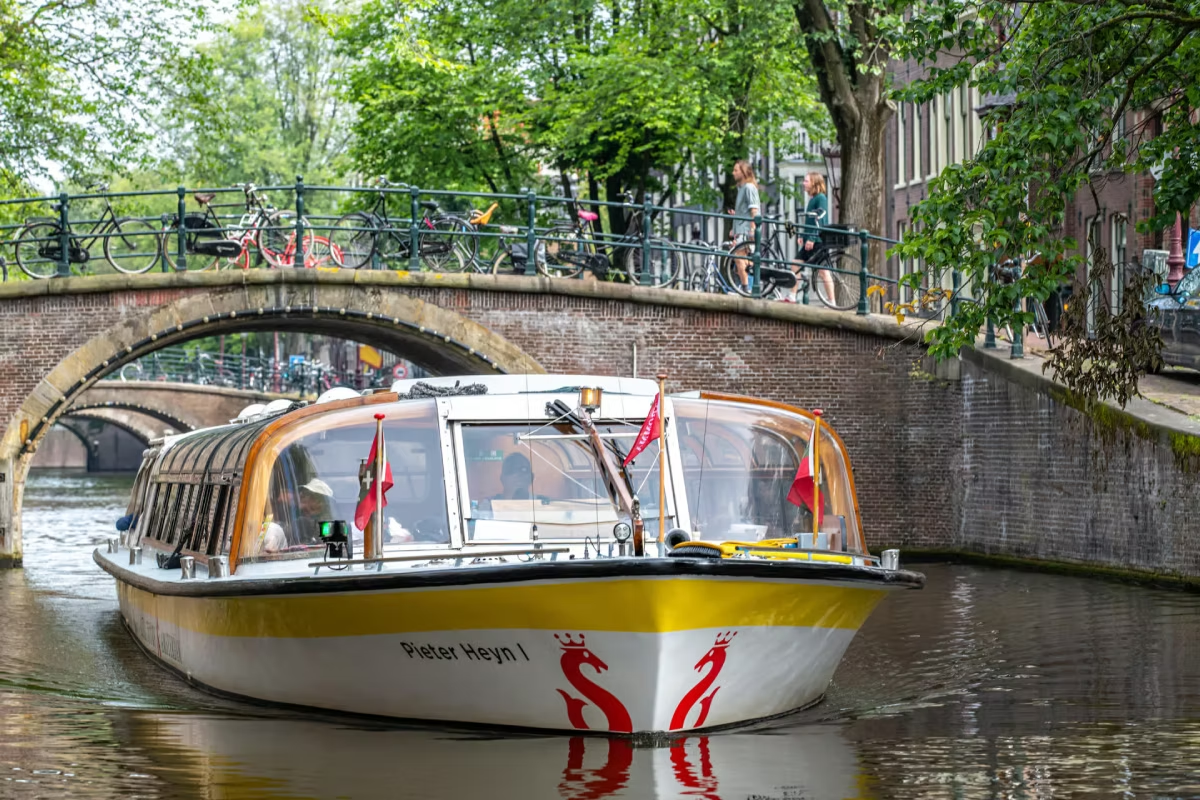
Amsterdam has more than 1,500 bridges — more than Venice. On a standard canal cruise you pass under and alongside dozens of these, including the famous Magere Brug (Skinny Bridge) over the Amstel River, the Blauwbrug (Blue Bridge), and the Reguliersgracht, where seven bridges are visible in a single line of sight. The bridges are one of the canal ring’s most defining visual features and are experienced differently — and more dramatically — from the water than from the towpath above.
Amsterdam is often called the city of canals, but it could equally be called the city of bridges. With more than 1,500 bridges spanning its 165 canals, Amsterdam has one of the densest bridge networks of any city in the world — more bridges than Venice, more than London, more than Paris. From a canal cruise boat at water level, these bridges are not simply things you cross — they are architectural objects you pass through, under, and alongside, experiencing their structure from below in a way that changes how you understand them.
This guide covers the most significant bridges visible on a standard Amsterdam canal cruise, explains what to look for as you pass each one, and gives the historical context that makes individual bridges more than anonymous infrastructure.
Top Tickets
Amsterdam’s Bridge Statistics
Amsterdam has 1,539 bridges in total — a figure that makes it one of the most bridge-dense cities in the world. The oldest surviving bridge on the canal ring dates from the 17th century. The majority of Amsterdam’s bridges were built between 1850 and 1950 as the city expanded and modernised its infrastructure. Around 60 bridges are classified as national monuments. Approximately 400 bridges are movable — drawbridges or swing bridges that open to allow taller vessels to pass.
The scale of Amsterdam’s bridge network reflects the fundamental fact that Amsterdam is a waterway city — movement between its 90 islands (Amsterdam is built on 90 artificial islands separated by canals and the original river) requires bridges at almost every street crossing. Where other cities have street intersections, Amsterdam has bridge crossings.
Key bridge statistics:
- Total bridges: 1,539
- Movable bridges (drawbridges, swing bridges): Approximately 400
- Bridges classified as national monuments: Approximately 60
- Oldest surviving historic bridge type: 17th century (most individual bridges have been reconstructed multiple times)
- The Magere Brug: Amsterdam’s most famous bridge, the original dating from 1691
The Magere Brug (Skinny Bridge)
The Magere Brug (Skinny Bridge) is Amsterdam’s most famous bridge — a narrow, white-painted wooden double drawbridge crossing the Amstel River at the Kerkstraat. A bridge has stood on this site since 1691. The current bridge is a reconstruction from 1969. At night, it is illuminated by approximately 1,200 small lights that reflect in the Amstel water below. The bridge opens regularly for boat traffic, and observing it open and close is one of Amsterdam’s characteristic waterway experiences.
The Magere Brug gets its name from its extreme narrowness — the original bridge was barely wide enough for two people to pass each other, hence “skinny” (mager). The story most commonly told is that it was commissioned by two wealthy sisters named Mager who lived on opposite banks of the Amstel and wanted a private crossing between their homes, but historians consider this a charming invention rather than documented fact.
From a canal cruise boat, the Magere Brug is experienced as an approach — the white structure visible from some distance down the Amstel as the boat turns into the river — a passage under the bridge arch if the drawbridge sections are lowered, and then the view back as the boat continues. At night, the 1,200 lights strung along the bridge’s structure create a constellation of white light that reflects in the dark Amstel water below in what is arguably Amsterdam’s single most photogenic visual.
The bridge opens regularly throughout the day to allow taller vessels to pass. Watching the two leaf sections of the drawbridge rise — the counterweights descending as the bridge sections pivot upward — is one of Amsterdam’s characteristic waterway moments. If you are on a boat small enough to pass under the bridge without it opening, you may see it open ahead of you and then close again — a sequence that gives a sense of the constant water traffic management that Amsterdam’s 165 canals require.
The Reguliersgracht and the Seven Bridges View
The most famous single view in Amsterdam’s canal network is from the Reguliersgracht, where seven bridges are visible in a single line of sight looking south from the junction with the Herengracht. This view — seven consecutive bridge arches receding into the distance along the straight Reguliersgracht — appears on more Amsterdam postcards and photographs than almost any other image. It is best seen in the evening when the bridges are illuminated and their reflections multiply in the canal water.
The Reguliersgracht is a relatively minor cross-canal on the canal ring — it crosses the three main concentric canals (Prinsengracht, Keizersgracht, and Herengracht) and continues toward the Amstel. What makes it famous is a single photographic accident of geometry: standing at the junction of the Reguliersgracht and the Herengracht and looking south, seven consecutive bridge arches align in a perfectly straight sequence that recedes into the distance.
The seven bridges in view are at the intersections of the Reguliersgracht with the Herengracht, Keizersgracht, Prinsengracht, and the four cross-streets in between. The fact that they are all on a single straight canal, at roughly equal spacing, and all visible simultaneously from one point is an unplanned consequence of the canal ring’s geometric regularity — but the effect is remarkable.
From a canal cruise, the seven bridges view is best appreciated by looking down the Reguliersgracht as your boat crosses it on the Herengracht. The alignment is visible for only a brief moment as the boat’s position aligns with the straight canal — but it is one of the most specifically Amsterdam moments on any standard sightseeing cruise.
At night, the seven bridges illuminated and reflected in the Reguliersgracht water is one of Amsterdam’s most extraordinary visual experiences.
The Blauwbrug (Blue Bridge)
The Blauwbrug (Blue Bridge) is a large stone bridge crossing the Amstel River near the Waterlooplein. Despite its name, the current bridge — completed in 1884 — is not blue but grey stone. The original blue-coloured wooden bridge that gave it its name was demolished in the 19th century. The current Blauwbrug was modelled on the Pont Alexandre III in Paris and is one of Amsterdam’s most ornate and monumental bridges, decorated with stone figures, ship prow ornaments, and cast-iron lamp standards.
The Blauwbrug is significantly larger and more elaborate than most Amsterdam bridges — its stone arches, decorative balustrades, and ornamental lamp standards give it a grandeur that is more Parisian boulevard than Dutch canal ring. The bridge was built during the Rijksmuseum period of Amsterdam’s architectural ambitions, when the city was constructing several major public buildings in an eclectic historicist style.
From a canal cruise on the Amstel, the Blauwbrug is one of the most visually imposing bridges you will pass — its large arched span and ornamental detailing are clearly visible from the water and make a strong contrast with the simpler, more functional canal ring bridges.
The Torensluis — Amsterdam’s Widest Bridge
The Torensluis on the Singel (the canal inside the main ring) is the widest bridge in Amsterdam — 42 metres wide at its broadest point. It was built in 1648 on the site of a sluice gate, and its exceptional width results from the fact that a prison was housed in the bridge’s hollow structure (the cells are still visible below the bridge surface). The Torensluis is now used as a public gathering space — café terraces extend across its width in summer.
From a canal cruise on the Singel, the Torensluis is experienced as a wide, low bridge that the boat passes under at very close range to the underside — the prison cells’ ventilation openings visible in the bridge structure above.
What to Notice When Passing Under a Bridge
Experiencing Amsterdam’s bridges from a canal boat is fundamentally different from crossing them on foot. Here is what to look for as your cruise passes each major bridge:
The arch structure. Look up as you pass under a bridge — the underside of the arch is visible from the boat in a way that is completely hidden from pedestrians above. Stone bridges reveal the construction of the vault; iron bridges show the structural web of their underside; wooden drawbridges show the timber framing. This underside view is the canal boat’s exclusive architectural perspective.
The sluice mechanisms. Amsterdam’s movable bridges (drawbridges and swing bridges) have visible mechanical mechanisms — the counterweights, the pivot mechanisms, the motor housings — that are interesting as engineering objects. From the boat, you often pass directly adjacent to these mechanisms.
The bridge numbers. Amsterdam’s bridges are all numbered — the Magere Brug is bridge number 245, for example. The number plates are typically visible on the bridge structure. This numbering system helps navigation but also gives each bridge a specific identity within the city’s infrastructure network.
The reflections. At any time of day, the reflections of bridges in Amsterdam’s canal water are one of the most rewarding visual elements of a canal cruise. The reflection appears directly below the bridge — an inverted mirror image in the water that perfectly doubles the visual presence of the bridge above it.
Amsterdam Bridge Facts Worth Knowing
Amsterdam has more bridges than Venice. Venice has approximately 400 bridges across its canals. Amsterdam has 1,539. The comparison is frequently made in tourist literature about Amsterdam and is accurate.
Around 400 Amsterdam bridges are movable. These include drawbridges (where sections lift vertically) and swing bridges (where the bridge pivots sideways to open). The operation of these bridges is managed by the Amsterdam city government, which coordinates openings with canal traffic.
The Magere Brug opens at specific times. The Magere Brug opens for boat traffic on a regular schedule throughout the day. If you are hoping to see it open, check the bridge’s operating schedule — it is available on the Amsterdam city government website.
The oldest bridge style on the canal ring is the humpback. The characteristic humpbacked brick bridges of the Amsterdam canal ring — low, arched, with a gentle rise in the middle — date in their current form mostly from the 17th to 19th centuries, though individual bridges have been reconstructed multiple times.
Some Amsterdam bridges are accessible by bicycle but not by car. Many of the narrower bridges on the Prinsengracht and Keizersgracht are too narrow for cars and are pedestrian and bicycle bridges only. From a canal cruise, you can see which bridges carry what traffic by observing the surface width and the presence or absence of cycle lanes.
Frequently Asked Questions
How many bridges does Amsterdam have?
Amsterdam has 1,539 bridges. This makes it one of the most bridge-dense cities in the world — more than Venice, more than any comparable European canal city.
What is Amsterdam’s most famous bridge?
The Magere Brug (Skinny Bridge) over the Amstel River is Amsterdam’s most famous and most photographed bridge. Its narrow white-painted wooden structure, illuminated at night by 1,200 small lights, is one of Amsterdam’s most iconic images.
What is the seven bridges view in Amsterdam?
Looking south from the junction of the Reguliersgracht and the Herengracht, seven consecutive bridge arches are visible in a single line of sight. This view appears on numerous Amsterdam postcards and photographs and is best appreciated in the evening when the bridges are illuminated.
Can you go under the Magere Brug on a canal cruise?
Yes — if the drawbridge sections are in the lowered position, canal cruise boats of standard height can pass under the Magere Brug. The bridge opens regularly for taller vessels. Whether your boat passes under it or waits for it to open depends on your vessel’s height and the bridge’s current position.
Are Amsterdam’s bridges illuminated at night?
Yes — many of Amsterdam’s bridges have lighting installed that illuminates them after dark. The Magere Brug is the most dramatically lit, with 1,200 small lights covering its entire structure. The effect of illuminated bridges reflecting in Amsterdam’s canals at night is one of the city’s most distinctive visual qualities.
